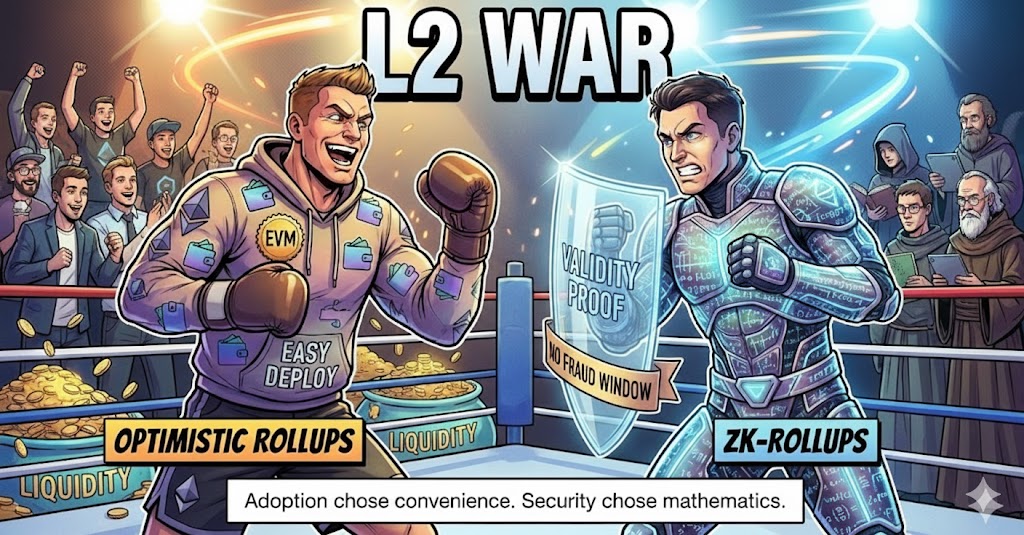
The Competition of Layer-2 Solutions is not about concepts or what they can provide to the blockchain ecosystem but rather about who has the deepest pockets, the most talented engineers, lasting architectures, and can provide robust ecosystems for many years without failure.
How do we know if the market made the right decision when choosing one over the others? Comparing the various types of rollups requires a thorough evaluation of not only the technology presented but also the presence of ease of use, coupled with cryptographic certainty, which for many, could take years to prove.
Optimistic Rollups: Market Winners Based on Trust
Optimistic rollups operate on the assumption that each transaction presented is valid unless proven otherwise; they submit multiple off-chain transactions to Ethereum as calldata without first performing any validation checks on those transactions. In an effort to reduce false claims of transaction validity, the optimistic rollup networks give the transaction validators seven days to dispute the validity of a group of transactions sent to Ethereum. Once this seven-day dispute window has closed without any applications for dispute being filed against that transaction batch, that transaction batch is officially complete and valid.
This assumption of transaction validity is simultaneously the greatest strength and the greatest weakness of this type of rollup architecture. The optimistic rollup does not require extensive proofs of validity for every single batch transaction it creates and, therefore, optimistically rolls up transactions significantly less expensively than does a rollup that creates a single cryptographic proof for each transaction.
By September 2025, the optimism-based rollup architecture will have processed about 90% of all L2 transactions. Of that 90%, Base will have contributed to more than 60%, which means that Base, along with Arbitrum, are controlling a significant portion of the market share of L2 DeFi.
A large proportion of developers and end users made a choice for ease of use over the claim of cryptographic validity-based development, which is seen in the statistics showing that Base and Arbitrum account for 52.5% and 46.6%, respectively, of the combined total value locked of approximately $5.6 billion in L2 DeFi.
The Seven-Day Problem: Why Instant Finality Matters
The experience for ZK-rollup supporters while addressing the fraud-proof challenge was certainly one that has not been forgotten. Whereas positive roll-ups are so time-consuming to deal with and do not offer a speedy method of settlement due to how long it takes to resolve disputes up to seven days for transferring assets onto the Ethereum main network. With fast withdrawal services, customers may receive their borrowed assets immediately for a small fee but doing so increases the risk associated with the transaction for the other party, as well as goes against the concept of trustless transactions which is one of the most important features of a blockchain.
The time delay associated with positive roll-ups would hinder NFT applications, transactions that require prompt completion, and therefore applying a seven-day finality period would severely limit the ability to utilize the full benefit of the core value proposition of a given application. ZK-rollup transactions allow for immediate finality once the smart contract has established that it is a legitimate transaction, and as such, the difference between the two designs matters most when applications require assurances of finality and consistency of settlement in the future.
Cryptologically Superior ZK-Rollups Without Users
To validate each transaction before submitting them to Ethereum, ZK-Rollups, use Zero-Knowledge Proofs to check every transaction and confirm that the total number of transactions in an individual batch update the state of the roll-up to a specific point via cryptographic evidence submitted to the main chain for a mathematical verification using the smart contract. It is possible to detect issues without fraud challenge periods, timeframes to dispute wrongdoings, or any honest validators being involved.
As such, ZK-rollups offer greater security-related guarantees. Using ZK-Rollups to prove the legitimacy of the transaction on-chain eliminates the ability for a bad actor to submit a fraudulent transaction during the dispute period but without objections being raised. ZK-Rollups produce enormous amounts of data with compressed storage, producing state diffs that compress 283,905 bytes to 88,693 bytes, lowering the costs of data availability. Thus, many ZK advocates cite ZK-Rollups' long-term cost advantages due to their high proof computation overhead.
Currently, ZK-Rollups are still primarily niche products. By 2025, ZK-Rollup's total value locked (TVL) reached $28 billion; however, they are significantly outperformed by Optimistic alternatives. The amount of computational resources required for Zero-Knowledge Proofs is quite high, and the majority of ZK-Rollups do not support EVM. StarkNet's zk-STARKs enable the volume of Industrial Scale to take place but require specialized tooling for development, and therefore limit how many programs can deploy without substantial rewriting. zkSync Era has achieved a processing rate of 20,000 TPS with its zkEVM technology.
The Decentralization Reality Check
The marketing for both optimistic rollup architectures fails to address some of the underlying issues associated with a centralized system. All three of these platforms are built using a fraud-proof system that does not require permission, and are therefore optimistically rolled-up in stage 1. However, execution still occurs through a centralized sequencer that creates a single point of failure. Despite the existence of a fraud-proof proof on the network, participants must still trust that the operators of the sequencer are not filtering transactions or modifying orders to benefit themselves.
Most zero-knowledge rollup networks rely on one prover or a small number of controlled circuit groups. This creates a heavy processing burden on individuals seeking to validate a zero-knowledge proof, especially considering that the majority of the Compliant Validator Network (CVN) still does not offer decentralization options for provers. However, for ZK rollup networks, StarkNet was the first to achieve this in stage one of the development process. Thus, neither of these methods has reached the true, decentralised view of trustless networks through their designs.
Developer Experience Gap
Staying EVM-compatible from the start helped optimistic rollups win developer adoption. Arbitrum Virtual Machine and Optimism's Optimistic Virtual Machine let developers port Ethereum smart contracts with few changes, eliminating deployment obstacles and enabling mainnet and L2 project launch. Every Ethereum-compatible wallet, tool, analytics platform, and infrastructure provider supports optimistic rollups.
ZkEVMs specialized virtual machines that generate zero-knowledge EVM execution proofs are needed for ZK-rollups. ZkEVMs are difficult to build, and early implementations broke Ethereum opcodes. Polygon and zkSync Era, which increase compatibility by building toward Type 2 EVM equivalence and Type 4 where source code compiles to ZK-optimized languages, improved compatibility. Development continues harder than expected. Fewer auditors know ZK circuit coding. Proof failures are harder to debug than smart contracts. The tooling ecosystem is years behind.
The Meaning of "Technically Superior"
Ideal rollups boost developer productivity, follow-through, interoperability with EVMs, and transaction speed, whereas ZK-rollups provide rapid settlement times, verified security and privacy, reduced data costs, and fraud elimination ZK-rollups benefit from fast-settlement payment infrastructure, hence a DeFi protocol should use optimistic rollup technology to maximize interoperability with the top three networks (Base, Arbitrum, and Optimism).
The three top networks' consolidation is due to "path dependence" and "technical quality." Liquidity, client bases, and network effects made early users' networks uneconomical for new enterprises. Numerous Ethereum L2s will disappear if users predominantly use one of these three networks and transaction volume drops by above 61% by 2026. Even the largest and most sophisticated ZK implementations will likely fail without a substantial inflow of users and wealth if they are new. Recent top three network consolidation will increase "Hopeful" rollups.
Gaming, cross-chain bridges, privacy applications, and institutional infrastructures that demand immediate withdrawals may use "hopeful" rollups that offer general-purpose DeFi or 7-day apps. ZokEVMs will close the technology gap between ZK-based chains and "hopeful" rollups. Instead of the "right" technology, users and investors worry about a rollup solving a problem and producing several applications. The "smartest" evidence will release items and catch tech-enabled commercial distributions before networks.