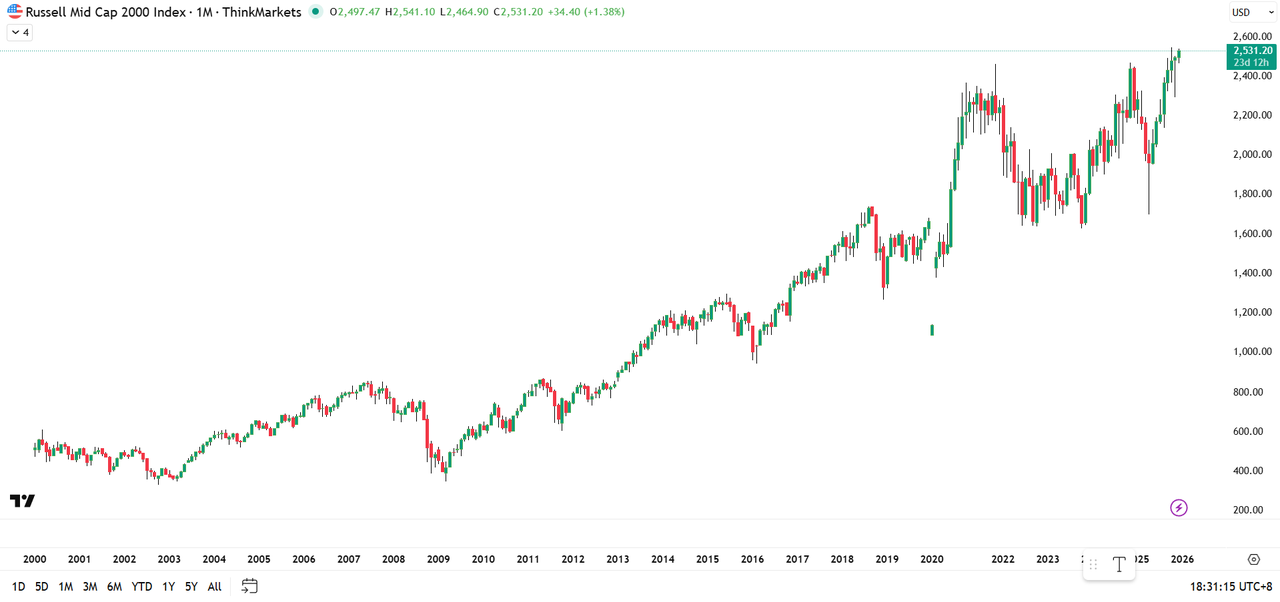
First, Understand What the Russell 2000 Is
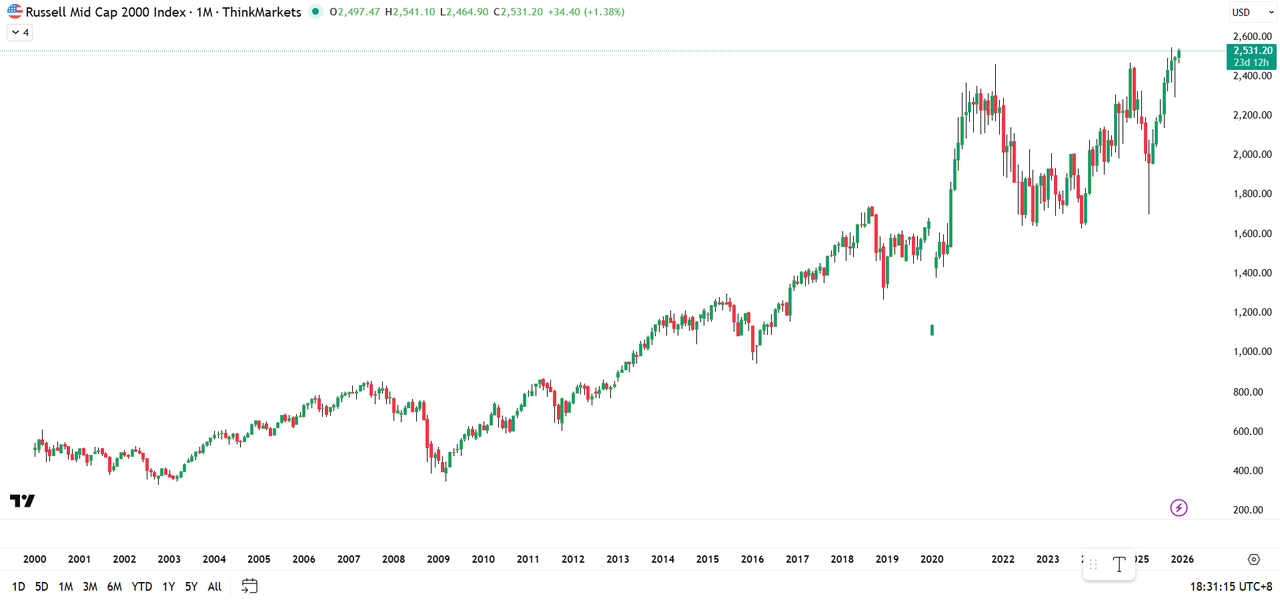
The Russell 2000 can be thought of as a collection of small-cap U.S. public companies—those that are relatively new, have compelling "stories," and a high demand for capital.
Many of these companies have less mature financial health and smaller market caps; the market values them based primarily on "growth and future potential."
Does this sound familiar?
It is almost identical to the logic behind Web3 projects.
Why Does It Affect the Crypto Market?
1. Small-Caps and Crypto Are Both "Risk Assets":
Investors only buy higher-risk assets when they have surplus capital and strong confidence. In other words, a rising Russell 2000 means the market is willing to take risks; a weakening Russell 2000 trend means the market is pulling back. The Web3 world is extremely sensitive to this sentiment.
2. It Is a Liquidity Barometer:
Small-cap stocks rely heavily on capital support. Whenever market liquidity loosens, the first to benefit are not large-cap tech stocks (where the money is already parked), but sectors requiring capital "irrigation" (Small-cap Tech → Crypto → High-leverage Derivatives).
Many funds, Algos, and quantitative models even utilize a progressive risk capital path: RTY (Russell 2000 Futures) → BTC → Altcoins.
3. Beta Expansion Effect:
S&P 500 = Established Blue-chips
Nasdaq = Growth Tech
Russell 2000 = High-risk Small-caps
Web3 = Speculative assets with developing revenue and business models
Therefore, when market risk appetite recovers, the sequence of gains is usually: Large-caps → Small-caps (Russell) → BTC → Altcoins → Memecoins & High Leverage.
If you go ALL-IN before the rotation cycle reaches Crypto, the market will feel "stagnant" to you.
But that isn’t a bear market; it is simply not your turn yet.
Observations from Actual Data
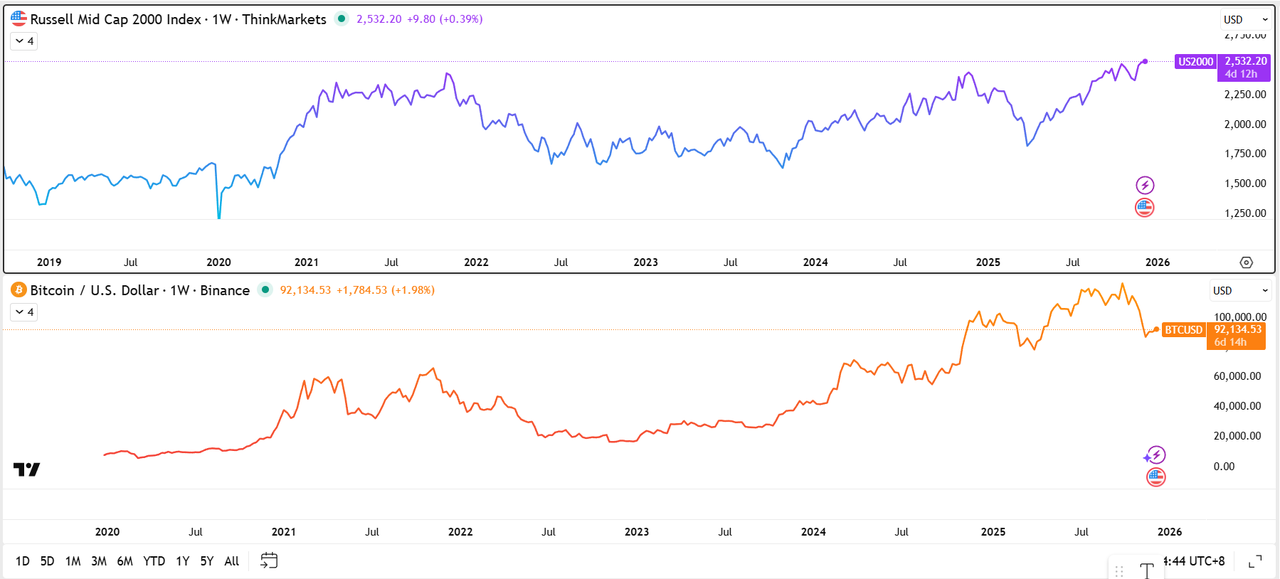 Overlaying the trends from 2020–2025 reveals:
2020 Q3 → Q4
Russell 2000: Bullish breakout → Capital flows back to small-caps
Crypto Market: BTC ignites → followed by ETH → finally an Altcoin rally, entering the early bull market phase
2021 Q2
Russell 2000: New highs reached but the trend slows
Crypto Market: Bubbles begin to form → Memecoins and GameFi explode
2022 Full Year
Russell 2000: Crash combined with interest rate hikes
Crypto Market: Crash → flushing out market leverage
2023 Q4
Russell 2000: Trends higher again
Crypto Market: BTC reacts first → market warms up
2025 Current Stage
Russell 2000: Leading the rally / Risk appetite returning
Crypto Market: Beginning to recover, though capital remains concentrated in BTC/ETH
Our observation is:
Most crypto rallies are not "self-ignited" but move in tandem with the global capital scale.
Practical Implementation Methods
Having identified these correlations, we can use this framework to judge potential crypto market trends:
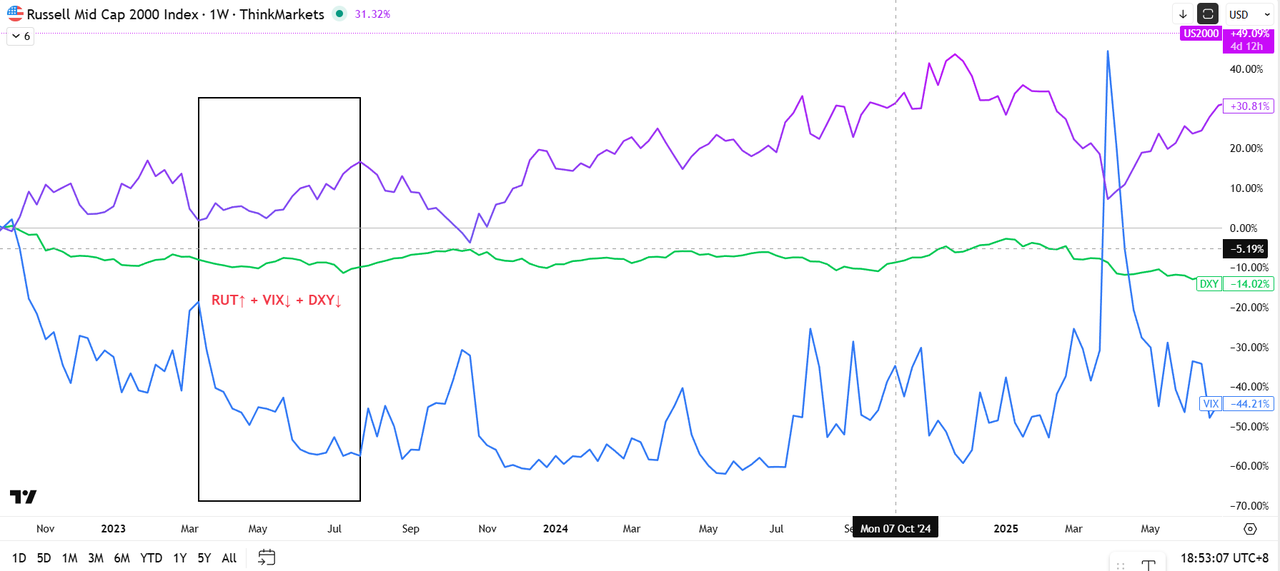
👉 Step 1: Observe Three Indicators
Judging the direction:
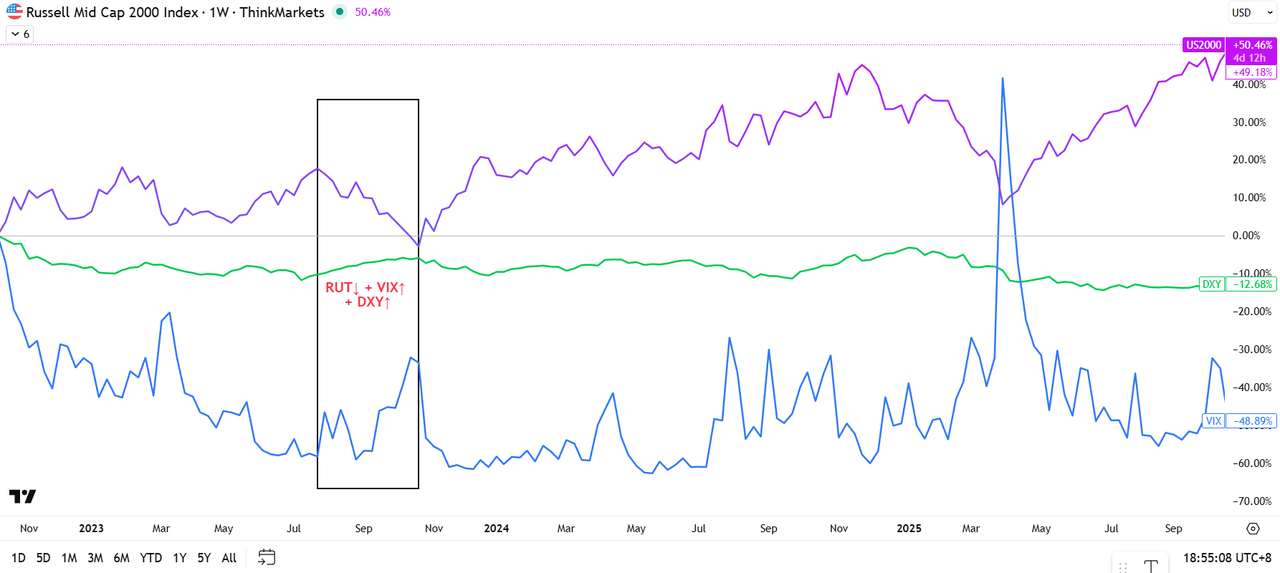
RUT↑ + VIX↓ + DXY↓
Capital is flowing into risk assets; overall bullish; time to gradually position into altcoins.
RUT↓ + VIX↑ + DXY↑
Capital is retreating; seek safety in crypto or de-leverage.
RUT↑ but VIX or DXY are not in sync
The market is hesitant; stay on the sidelines and avoid heavy positioning.
👉 Step 2: Observe Crypto Capital Rotation
I usually divide the market into four layers:
1. BTC
2. ETH
3. Emerging L1s/L2s, hot sectors, and strong narrative tokens
4. Small-caps & Memecoins
When rotation reaches the 3rd and 4th layers, it means the bull market has entered the "mania phase." Before then, do not be impatient.
While Crypto may seem like its "own world," it remains deeply connected to global liquidity, risk appetite, and capital rhythm.
The Russell 2000 is a highly practical indicator that can tell you in advance if the market is ready to take a risk once again.