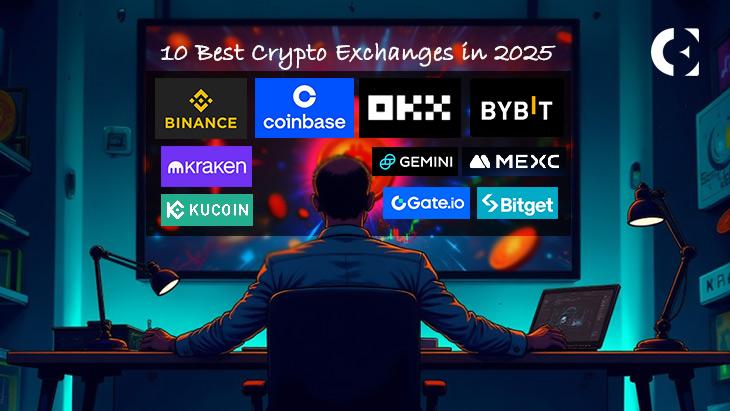
The global crypto exchange market in 2025 looks nothing like it did just a few years ago. Following a turbulent 2024 marked by high-profile security breaches and tightening regulations, 2025 ushered in a more mature, security-conscious trading environment.
The global crypto exchange market in 2025 looks nothing like it did just a few years ago. Following a turbulent 2024 marked by high-profile security breaches and tightening regulations, 2025 ushered in a more mature, security-conscious trading environment.
Platforms that once competed on token variety or marketing buzz are now being judged by stricter standards, transparency, compliance, and user protection.
In the past years, incidents like the Bybit breach and the WazirX attack underscore how fragile centralized systems can be without advanced security standards. Yet, rather than deterring users, these events have accelerated innovation.
Leading platforms are now rolling out proof-of-reserves audits, AI-powered fraud detection, and multi-layered cold-storage security to reassure traders that their assets are safe.
At the same time, regulatory shifts are reshaping how exchanges operate. The U.S. SEC’s updated digital asset framework in 2025, coupled with global efforts by the G20’s Financial Stability Board, has forced many exchanges to adopt clearer operational standards.
This evolution has created a new generation of platforms that blend low trading fees, strong compliance measures, and mobile-first accessibility, making crypto trading more secure and user-friendly than ever.
In this guide, we explore the 10 best crypto exchanges redefining digital asset trading in 2025, highlighting how they combine affordability with top-tier security and innovation to meet the demands of both beginners and seasoned traders.
Cryptocurrency exchanges serve as the foundation of the digital asset economy, acting as gateways between traditional money and the world of decentralized finance. Simply put, they are online platforms where users can buy, sell, and trade cryptocurrencies such as Bitcoin, Ethereum, or stablecoins using either fiat currency or other digital assets.
These crypto trading platforms operate much like traditional stock exchanges, using order books to match buyers and sellers, but with the added advantage of operating 24/7 and across borders.
Over time, two dominant models have emerged: centralized exchanges (CEXs) and decentralized exchanges (DEXs). In 2025, the distinction between the two has blurred as hybrid platforms combine the best of both worlds, providing the usability of centralized systems with the transparency of blockchain verification.
But with more than 500 active bitcoin exchanges and trading platforms worldwide, how can users know which ones to trust? The most reliable crypto exchanges today share several defining traits.
Regulation tops the list. Exchanges that comply with global standards, maintain licenses in multiple jurisdictions, and undergo regular third-party audits are viewed as the safest crypto exchanges.
Proof-of-reserves (PoR) verification has also become standard practice, allowing users to independently confirm that their deposited funds are fully backed.
Security is another non-negotiable factor. The best platforms now integrate AI-driven fraud detection, biometric authentication, multi-signature wallets, and insurance coverage for custodial assets.
Meanwhile, usability has become a major differentiator, with each major exchange offering a dedicated crypto exchange mobile app designed to simplify onboarding for new traders.
Transparency, compliance, and intuitive design are shaping what users expect from the best crypto exchanges in 2025. Whether someone is a first-time investor or an experienced trader, the leading platforms today combine low fees, high liquidity, and institutional-grade safeguards to ensure that crypto trading remains profitable, safe, and accessible to everyone.
The crypto exchange ecosystem in 2025 is increasingly consolidated, with a handful of dominant players capturing the majority of trading activity. Here are the ten exchanges currently setting the benchmark for security, liquidity, and cost efficiency.
Binance remains the largest cryptocurrency exchange by a wide margin. As of Q3 2025, it accounts for roughly 42.3% of global spot trading volume, processing nearly $700 billion in monthly transactions. Its influence extends across 180 countries, with over 150 million registered users.
Binance charges 0.10% base maker and taker fees, offering a 25% discount for users paying with BNB. The exchange runs as one of the most robust proof-of-reserves systems, audited by Deloitte in 2025. It operates a user protection fund known as SAFU, currently holding assets valued over $1 billion.
While Binance continues to lead on liquidity and product diversity, it remains under close regulatory watch in regions like Australia and the EU. Despite this, its scale, innovation, and rapid technical response keep it dominant.
Coinbase is widely regarded as the most compliant and beginner-friendly exchange for U.S. users. Listed on NASDAQ since 2021, it provides rare public transparency through quarterly financial reports. In Q2 2025, Coinbase reported $234 billion in trading volume, reflecting a 28% increase year-over-year.
Its fee structure varies from 0.15% to 0.60% depending on trade volume and interface type. While its retail version is more expensive, the advanced platform offers competitive rates for frequent traders.
Coinbase secures 98% of user assets in cold wallets and maintains $320 million in insurance coverage. It’s one of the few exchanges meeting both U.S. and EU regulatory requirements under MiCA (Markets in Crypto-Assets Regulation). Though limited in token selection, it’s ideal for security-conscious users.
OKX has evolved into a global derivatives leader, occasionally surpassing Binance in futures volume. In September 2025, its derivatives market hit $1.3 trillion in monthly volume. OKX’s strength lies in its sophisticated product suite, including options, perpetual futures, and staking services.
The platform uses multi-tier cold storage and AI-based fraud detection systems. Its proof-of-reserves is updated monthly, allowing users to verify holdings against liabilities. OKX’s integrated wallet and DeFi dashboard make it a top pick for traders seeking exposure beyond spot trading.
While its leverage products attract professionals, beginners should proceed cautiously due to volatility risks.
Bybit gained prominence for its fast engine and deep derivatives liquidity, recording $376 billion in Q3 2025 trading volume. However, in February 2025, it suffered a $1.5 billion security breach, the largest in exchange history.
To its credit, Bybit swiftly compensated affected users and rebuilt confidence through expanded insurance coverage, third-party audits, and zero-fee BTC/USDT trading campaigns that attracted institutional flow.
Today, it ranks among the top five global derivatives venues. Its transparent response to the hack and ongoing reforms serve as a case study in crisis recovery and operational resilience.
Founded in 2011, Kraken has built its reputation on longevity and reliability. It’s among the few major exchanges never to have lost customer funds to a hack. In 2025, Kraken became the first to complete a publicly verifiable proof-of-reserves audit under new U.S. accounting standards.
Over 95% of assets are stored in air-gapped cold wallets. The platform uses FIDO2 hardware authentication, no SMS recovery options, and frequent penetration testing. Kraken also expanded into U.S. derivatives through a $100 million acquisition of Small Exchange in October 2025.
While fees, up to 0.40% taker rate, are slightly higher, Kraken’s credibility and security-first architecture make it one of the safest trading venues in 2025.
KuCoin continues to dominate the altcoin segment, hosting over 800 tradable assets. Known for accessibility in emerging markets, it maintains low fees averaging 0.10% for both makers and takers.
Following a 2020 breach, KuCoin implemented full reimbursement and overhauled its security model with upgraded risk management systems and multi-signature wallets. It now provides PoR updates and integrates staking, lending, and futures on a single interface.
However, its limited fiat support and regional restrictions keep it best suited for crypto-native users comfortable with stablecoin conversions.
Gemini, founded by the Winklevoss twins, operates under strict U.S. regulation and remains favored by institutions for its compliance-first approach. It maintains insurance coverage on custodial holdings and adheres to SOC 2 Type 2 cybersecurity standards.
While its 2025 spot volume trails larger peers, Gemini remains a preferred platform for professional investors who prioritize security over low fees. The main drawback is cost — trading fees can exceed 0.35%, and altcoin listings are limited compared to global rivals.
MEXC has expanded aggressively across Asia, Africa, and Latin America, offering access to over 4,200 cryptocurrencies, one of the broadest catalogs in the industry. It became a gateway for new tokens post-launch, appealing to traders seeking early exposure.
The platform charges 0.1% per trade and supports multiple fiat options. While MEXC lacks the full transparency of tier-one exchanges regarding PoR audits, it has gained traction among users looking for liquidity in smaller-cap assets.
Its fast listing process comes with risk. Not every project listed undergoes deep due diligence, but the platform’s volume growth highlights its global relevance.
Gate.io distinguishes itself with transparency. As of 2025, the exchange maintains 128% collateralization in reserves, verified through a Merkle-tree audit system with third-party validation.
It offers a diverse suite of products, including futures, margin trading, staking, and copy trading. However, despite its liquidity and openness, Gate.io’s user interface can be less intuitive, and regulatory clarity in certain markets remains limited.
For traders prioritizing proof-of-reserves assurance and access to niche tokens, Gate.io remains a solid mid-tier option.
Bitget has emerged as one of the fastest-growing exchanges, ranking among the top three globally for derivatives trading by late 2025. The exchange boasts over 800 supported assets, and in its latest audit, reported a 188% reserve ratio, making it one of the few platforms holding more collateral than liabilities.
Bitget popularized copy trading, allowing users to mirror strategies from experienced traders, and offers one of the best mobile trading apps in the market.
Its services, however, remain restricted in the U.S., and fiat deposit options are limited. Still, its consistent transparency reports and growing institutional adoption solidify its place among the most reliable exchanges this year.
This list evaluates exchanges based on:
When you’re new to crypto, selecting the right exchange matters more than chasing the lowest fees. Here are the criteria to use and red flags to watch based on what the top 2025 exchanges emphasize.
The crypto exchange market in 2025 is more mature, transparent, and regulated than ever. Major platforms like Binance, Coinbase, Kraken, and OKX now operate with regular proof-of-reserve audits, enhanced security frameworks, and stronger compliance oversight. For traders, these improvements mean safer custody, lower counterparty risk, and better access to global liquidity.
Beginners should focus on exchanges that combine verified security, clear regulation, and ease of use before exploring advanced products like derivatives or DeFi integrations. Whether for casual investing or professional trading, selecting a reliable exchange remains the foundation of a secure and efficient crypto journey.
A cryptocurrency exchange is a platform that lets users buy, sell, and trade digital assets using fiat or other cryptocurrencies. These platforms function like stock markets but run 24/7.
There are two main types:
The safest exchanges in 2025 combine strict regulation, transparent audits, and advanced security.
For most new users, Coinbase, Kraken, and Binance remain reliable starting points due to their transparency and compliance.