


Manta Network started in 2020 with a clear mission. The team wanted to fix privacy problems in DeFi. They built a modular blockchain system that uses zero-knowledge proofs. This creates a foundation for private and scalable Web3 applications.
The network uses a dual-chain approach. This design helps it serve different needs in the crypto ecosystem. Manta Pacific runs on Ethereum as a Layer 2. Manta Atlantic operates as a Layer 1 on Polkadot. Both chains work together to deliver privacy-focused infrastructure.
How Manta Network Works
The core technology relies on zero-knowledge cryptography. This lets users prove something is true without revealing the actual data. Think of it like showing someone you're over 21 without displaying your exact birthdate.
Manta Network combines this privacy tech with modular architecture. The system can adapt to market changes. It can scale without sacrificing security or privacy. This flexibility makes it different from traditional blockchain designs.
The team chose to build two separate networks for specific reasons. Each network handles different use cases. This specialization creates efficiency. Users get better performance for their specific needs.
Manta Pacific: The Ethereum Layer 2
Manta Pacific launched on testnet in July 2023. The mainnet went live on September 12, 2023. It quickly became known as the fastest-growing ZK Layer 2 on Ethereum.
The network integrates with Celestia for data availability. This choice cut gas fees dramatically. Users saved over $750,000 on gas fees after this integration. Manta Pacific became the most affordable ETH Layer 2 in terms of transaction costs.
Developers can build on Manta Pacific using Solidity. The network offers Universal Circuits. These circuits let developers add zero-knowledge features without learning new programming languages. This approach is called ZK-as-a-Service. The platform provides a ZK library. Developers can call ZK-enabled contracts easily. They can add privacy features with simple function calls. This removes technical barriers. More developers can build privacy-focused applications.
Manta Pacific also supports non-invasive compliance. Projects can use zkSBTs (zero-knowledge soulbound tokens) for verification. These tokens prove credentials without exposing sensitive details. Companies can meet regulatory requirements while protecting user privacy.
Manta Atlantic: The Polkadot Layer 1
Manta Atlantic serves as the fastest ZK Layer 1 on Polkadot. It focuses on a specific problem. The network brings programmable confidential identities to Web3. The primary tool is zkSBTs. These tokens work as on-chain credentials. They verify identity without revealing personal information. This creates modular compliance systems. Users control what data they share and when.
Manta Atlantic uses a zkAddress system. This is a UTXO-based private address model. It runs alongside traditional public addresses. Users can keep certain transactions shielded. They can mint SBTs privately. They can manage on-chain credentials without leaking identity data.
The separation between public and private addresses gives users choice. Some transactions need transparency. Others benefit from privacy. Manta Atlantic lets users decide for each transaction.
Victor Ji of Manta Network (Sovereign Radio)
The Team Behind Manta Network
Three co-founders built Manta Network. They brought experience from Harvard, MIT, and Algorand. Their backgrounds combine academia with practical crypto development.
Victor Ji joined as co-founder in October 2020. He handles product development. His education includes an MPA from Harvard Kennedy School and an MBA from Peking University. This background helps him understand both policy and business aspects of blockchain.
Shumo Chu co-founded both Manta Network and p0x labs. He works as an assistant professor at UC Santa Barbara. He got his PhD from the University of Washington. Before academia, he worked as a research scientist at Algorand. His research centers on privacy-preserving systems. This expertise directly shaped Manta's technical approach.
Kenny Li serves as COO and co-founder. He started mining Bitcoin in 2013. He holds an MBA from MIT Sloan. Li has become a recognized expert in zero-knowledge technology. He advises Zprize, a consortium focused on ZK innovation.
Security Incident in April 2025
Kenny Li faced a sophisticated phishing attack in April 2025. The Lazarus Group targeted him through Telegram. A contact invited him to a Zoom call. The interface looked legitimate. Team members appeared on camera.
The system prompted Li to download a script file. It claimed he needed a Zoom update. Li recognized the attack pattern. He left the call immediately. The contact deleted all messages and blocked him right away.
This incident shows the risks crypto leaders face. High-profile figures become targets for advanced persistent threats. The attack used social engineering and technical exploits. It highlights why security awareness matters in Web3.
Manta: Investment and Funding Data
Strategic investment has played a major role in Manta Network's growth. Manta Network raised $60.4 million across four funding rounds, with 30 investors participated, according to Crunchbase. The funding history shows steady financial support and validates the market interest in modular privacy solutions.
| Funding Round | Date | Amount Raised | Lead Investors |
| Pre-Seed | February 2, 2021 | $1.1M | Polychain Capital |
| Seed | October 19, 2021 | $5.5M | CoinFund, ParaFi Capital |
| ICO | November 16, 2021 | $28.8M | — |
| Venture (Series Unknown) | February 17, 2022 | — | YZi Labs Venture |
Binance Labs and Polychain Capital backed the project. These names carry weight in crypto. Their involvement signals confidence in Manta's approach. The funding helped Manta build both networks and grow the ecosystem.
The project also participated in Alliance DAO and Berkeley Blockchain Xcelerator. These accelerator programs provided mentorship and connections. They helped Manta refine its strategy and execution.
Understanding MANTA Tokenomics and Utility
$MANTA is the native utility and governance token for the ecosystem. The total supply at the genesis event was 1,000,000,000 tokens. The network has a minting rate of 2% per year. This inflation creates rewards for stakers who maintain network security. The initial circulating supply at the Token Generation Event (TGE) was 251,000,000 MANTA.
Token Utility Across Both Networks
$MANTA serves multiple functions. The utility differs slightly between Manta Pacific and Manta Atlantic.
Governance works on both chains. Token holders vote on network decisions. On Manta Atlantic, tokens carry voting weight for on-chain governance. Holders can propose referenda and elect council members.
Network fees operate differently on each chain. On Manta Pacific, token holders benefit from sequencer revenue and data availability gas savings. Demand for blockspace generates this revenue. On Manta Atlantic, users pay transaction fees in $MANTA. The network distributes these fees strategically: 72% goes to ecosystem projects, 18% goes to the treasury, and 10% goes to collators.
Staking and security apply primarily to Manta Atlantic. Stakers can delegate to collators or run their own nodes. The network allocates the annual 2% inflation to reward these security providers. This creates economic incentives for network protection.
Exchange and liquidity functions work on both networks. $MANTA serves as native liquidity and collateral on Manta Pacific. On Manta Atlantic, it acts as the native currency for peer-to-peer transfers. Users need $MANTA to purchase credentials like zkSBTs and zkKYCs.
Token Distribution and Vesting Schedule
The 1 billion token supply splits across multiple categories. Each category has different release schedules. This creates predictable supply dynamics.
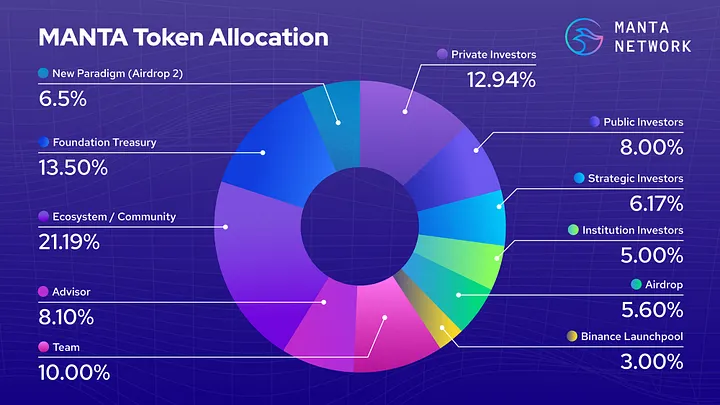
$MANTA Token Allocation, image source: Manta Network on Medium
The allocation of tokens ensures long-term ecosystem health. The "Ecosystem / Community" category received 21.19% of the supply. The "Team" received 10% with an 18-month cliff. "Private Round" investors hold 12.94% with a 12-month cliff. These vesting schedules prevent immediate sell pressure. The foundation manages liquidity flow between the two networks using a Celer bridge pool.
Cross-Chain Token Flow
The total supply exists across both Manta Atlantic and Manta Pacific. Tokens don't duplicate. They transfer between networks through the Celer bridge liquidity pool.
Tokens for private investors, institutions, foundation, team, and advisors launch on Manta Atlantic. Tokens for airdrops, Binance Launchpool, and ecosystem allocations launch on Manta Pacific. Users can bridge tokens between chains as needed.
The bridge uses a lock-and-unlock mechanism. When tokens move from one chain to another, they lock on the origin chain. An equivalent amount unlocks on the destination chain. This maintains the fixed total supply.
Key Milestones in Manta Network History
Comparison Between Manta Network and Sui
Investors often compare new blockchain projects to understand their specific niches. Manta Network and Sui Blockchain are both prominent, but they serve different purposes. Manta Network focuses on privacy and modularity. It uses Zero-Knowledge proofs to secure data. Sui focuses on high speed and scalability. It is a general-purpose Layer 1 blockchain.
Network architecture differs fundamentally. Manta uses a dual-network model. Manta Pacific operates as a Layer 2 on Ethereum. Manta Atlantic runs as a Layer 1 on Polkadot. Sui exists as a standalone Layer 1 blockchain. It doesn't rely on other ecosystems.
Technical focus separates the projects. Manta specializes in ZK-enabled applications. The platform makes privacy a core feature. Sui emphasizes parallel transaction processing. It achieves high throughput through architectural design rather than privacy features.
Programming languages create different developer experiences. Manta uses Solidity. Developers from Ethereum can transition easily. Sui uses Move, a Rust-based language. Move offers safety features but requires learning new syntax.
Core technology serves different goals. Manta combines zero-knowledge proofs with OP Stack and Celestia. This stack optimizes for privacy and cost. Sui uses parallel transaction execution. This design maximizes transaction speed and finality.
Transaction characteristics reflect the design priorities. Manta Pacific offers fast transactions with extremely low gas costs. The Celestia integration drove costs down significantly. Sui delivers instant transaction finality with high throughput. The parallel execution model prevents bottlenecks.
Use case alignment guides project selection. Manta suits projects that need privacy and leverage ZK technology. Financial applications, identity systems, and confidential voting benefit from Manta's approach. Sui works better for real-time applications. Gaming, social platforms, and high-frequency trading applications fit Sui's speed profile.
Operational Security and Future Outlook
Manta Network continues to expand its capabilities in the Web3 space. The integration of modular Data Availability through Celestia positions it well for cost-efficiency. The focus on compliance through zkSBTs solves a major hurdle for institutional adoption. Users can verify their identities without exposing personal data. This balance of privacy and compliance is a key driver for future growth.
The ecosystem relies on active participation for security. Stakers and collators maintain the integrity of Manta Atlantic. Governance votes guide the direction of Manta Pacific. The incident involving Kenny Li serves as a reminder of external threats. However, the network's internal architecture remains robust. The combination of low fees, privacy tools, and EVM compatibility suggests a strong trajectory for Manta Network.
