The way cryptocurrency is regulated currently in the US is largely through regulatory actions and lawsuits. In many Asian countries, countries alternate between banning and regulating. There is often a variance due to political influences within the local governments of various countries.
The European Parliament adopted the Market in Crypto-Assets Regulation (MiCA) to resolve this legal ambiguity concerning legislation on the use of crypto-assets, which is the first time that crypto legislation has been implemented across the EU in all 27 EU member states, and was signed into law on 30/12/2024.
Although the implementation of MiCA is problematic in many cases because of the regulatory policies towards the use of digital currencies, and also the inability of small and medium-sized enterprises to handle the costs associated with compliance, MiCA is the first piece of legislation with specific requirements concerning crypto-assets that applies to the 450 million citizens, and $17 trillion economy, of the European Union.
MiCA will lead to other countries passing legislation to regulate the use of cryptocurrencies globally, as MiCA provides a common basis for the establishment of international standards regarding the use of cryptocurrencies in every country, no matter how crypto companies may plan to operate.
MiCA Explained: Token Categories and Regulatory Scope
MiCA has three categories of tokens with different restrictions. The first category, Asset-Referenced Tokens (ARTs), encompasses stablecoins that are backed by fiat currencies or commodities. The second category, Electronic Money Tokens (EMTs), are stablecoins that are pegged to fiat currencies (EUR, USD, GBP). Finally, the third category contains utility tokens, governance tokens, and all other crypto-assets.
The greatest restrictions on custody will be imposed on stablecoin issuers. They are obligated to have custody of all financial assets and capital reserves. Stablecoin issuers are required to write lengthy whitepapers and be audited regularly. A stablecoin issuer must also maintain reserves for every token that it issues and disclose the composition of those reserves. The custody regulations for EMTs under MiCA are identical to those that apply to traditional e-money under the Electronic Money Directive.
CASPs operating within the EU are required to obtain a licence. With one licence, a CASP will be able to operate in every Member State of the EU. Under MiCA, a CASP that has a licence in one Member State may passport its business to all 27 Member States.
CASPs will need to notify customers when they make token offers, as well as follow the laws regarding insider trading and market manipulation. They will also need to maintain a separation of customer assets from their own funds in bank accounts. According to the Travel Rule, all crypto-transfers must contain the name of both the sender and the recipient regardless of the amount being transferred.
How MiCA Is Reshaping the Stablecoin Market
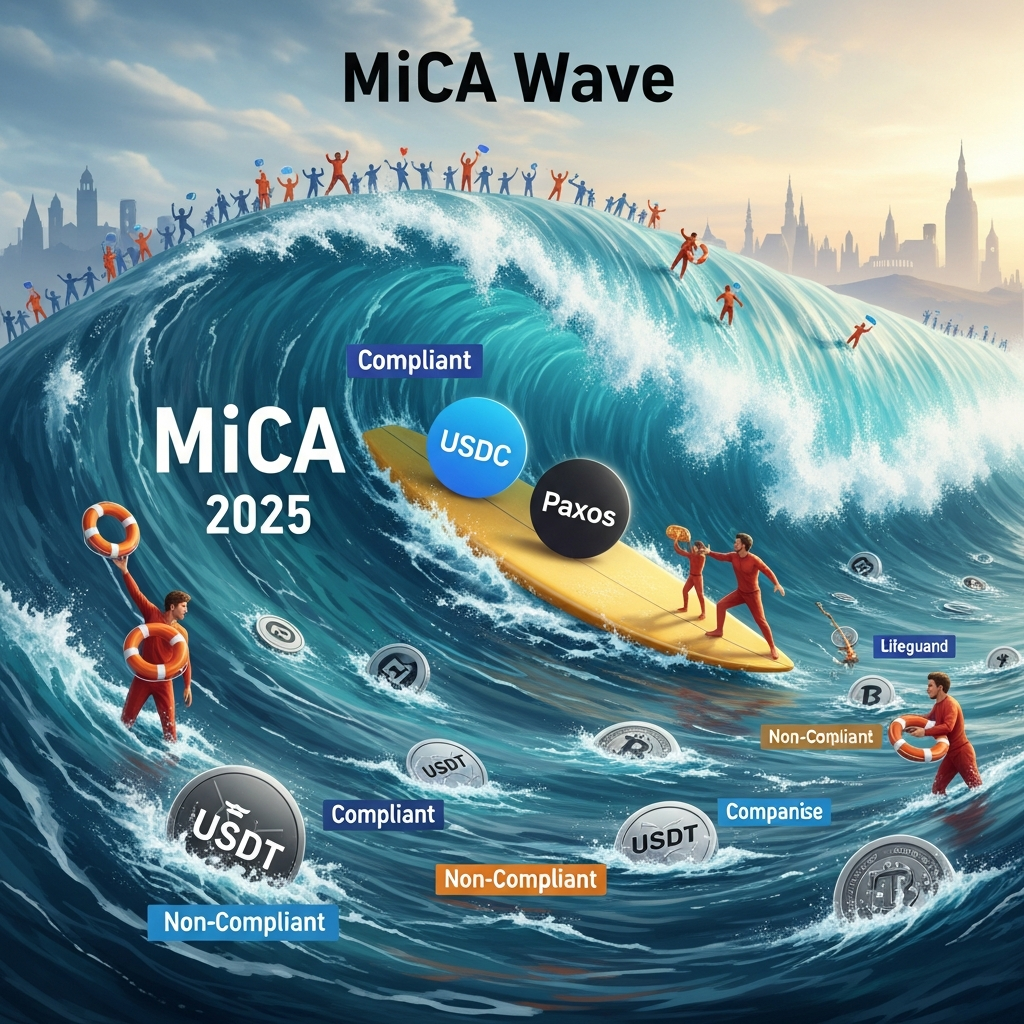
MiCA created a substantial effect on Stablecoins, making it illegal for exchanges to trade any Stablecoin that does not fall under MiCA until January 2025, after which it would likely be banned altogether, and will result in penalties being applied to those who do not comply. Tether, which has the largest market cap with $140 billion worth of coins in circulation, did not apply for MiCA approval; thus US exchanges have stopped allowing customers within the European Union to buy USDT. While Tether has not been in compliance, other Stablecoin issuers, like USDC, Paxos, and SG, have created compliant Stablecoins, allowing them to maintain their position as compliant asset offerings. Furthermore, since CASPs cannot accept or offer non-compliant assets, there is an increased market demand for compliance solutions.
With this change, USDC's market share increased in Europe while Tether's decreased, thus leading to shopping habits being altered as many European shoppers chose to use Non-US exchanges and change from Tether to USDC stablecoins. Thus, the law did clarify how stablecoins are used and issued. Eventually, Tether accepted the EU's regulations on Crypto Assets, acknowledging that if they did not comply with the EU's limits they would have lost hundreds of millions of users. Despite having objections from management at Tether regarding the EU regulations, management realised that they could not ignore such a large market.
CASP Licensing Under MiCA: Bottlenecks and Costs
By the end of 2025, 900 EU firms applied for CASP licenses, but only 40 obtained them due to the sheer number of applications and slow processing time by regulators rather than through any increase in demand. Therefore, the EU seeks to encourage crypto companies by providing faster licensing and clear guidelines on how to apply for a license. There are not many EU member states that are friendly to crypto companies; Malta, Luxembourg and France all have separate and specific licensing requirements while Germany and the Netherlands have much stricter licensing regulations.
This new "harmonised" system allows crypto companies to begin business in the most advantageous licensing jurisdiction while applying for licenses in other EU member states. This type of competition for a monopoly economic advantage through easy licensing is similar to the competition for financial services licenses that began 10 years ago.
Transitional regulations allow businesses that are currently active in the marketplace to continue operating until they receive their licenses. The first jurisdictions to issue these licenses will be the Netherlands in July 2025, while most other jurisdictions will not issue licenses until July 2026. All businesses operating in jurisdictions where they do not have a permit will be subject to prosecution after the grace period ends.
Substantial costs are involved in complying with compliance-related requirements. Larger companies have the financial resources to support capital investment, day-to-day operations and the reporting required for compliance, while smaller companies generally cannot. As a result, some companies are no longer in business, others have merged to reduce operating costs, and some companies raised money specifically to build a compliance-related infrastructure.
How MiCA Is Influencing Global Crypto Regulation
Many other jurisdictions have already adopted the MiCA requirements, while most of the others including Singapore adopted their Digital Token System to the MiCA model. Similar to MiCA in cryptocurrency product legislation, the United Kingdom has issued a proposal for MiCA-like legislation for crypto-based products. As part of the development process, numerous Governments in ASEAN are considering implementing the MiCA framework for regulation on bitcoin products.
The United States has established MiCA-like Federal Stablecoin Regulation through the GENIUS Act, which was passed in July 2025 and represents an evolution of the regulatory perspective from: "we will sue first, then clarify" to "let's set the rules in advance".
While only a small number of Governments currently have a complete set of MiCA-type regulations in place, the overall effects of those regulations are already widespread. The MiCA framework's classification system for Cryptocurrencies, in conjunction with MiCA's ART, EMT, and CASP classifications, has been adopted by numerous Countries. MiCA has laid the foundation for providing legal certainty on how to regulate cryptocurrencies and has proven that it is possible to provide fair consumer protections and to provide a legal framework for the creative development of new products without criminalising everything.
Under the GENIUS Act's MiCA-like compliance, Global stablecoins are being regulated by many countries to reduce or eliminate unregulated global stablecoins. Countries believe if they ban global unregulated stablecoins, then other countries may follow suit. MiCA provides an alternative to this.
MiCA Implementation Challenges for DeFi and Web3
The overlap between MiCA and PSD2 creates difficulties for companies attempting to comply with both regulations. EMT custodians hold both MiCA and payment services licenses, resulting in triple the regulatory burden on EMT custodians. MiCA lacks a sufficient definition of decentralised finance (DeFi). MiCA is not applicable to so-called "fully decentralised" platforms that have no operators, however, it is unclear how such platforms would actually operate. Most DeFi protocols are managed by foundations, and many also include treasury tokens and other governance mechanisms for platform operations.
The lack of clarity regarding whether a DeFi protocol is regulated or unregulated by MiCA has resulted in significant difficulty for European DeFi protocols in being able to achieve sustainable compliance with MiCA. MiCA does not apply to non-fungible tokens (NFTs). An NFT can be a financial instrument or an investment product based on its characteristics.
If NFTs have multiple owners or if they have financial qualities, they may fall into MiCA's regulatory scope. While this narrow exclusion benefits art and collectibles, it fails to address other uses of NFTs, including gaming, loyalty, and complex financial relationships.
Regulatory enforcement has increased substantially. In H1 2025, ESMA & its member states completed 230+ Audits, & had issued €540m in penalties by 2025 due to ongoing investigations by regulators restricting access to the European market. Regulators are serious about enforcing MiCA.
What Comes Next After MiCA Implementation
An interim report on the effects of MiCA on the market from the European Commission is expected to be published in June of 2025, however, all reviews of this legislation must be completed by December of 2025. This review will not only expose gaps within MiCA's Regulation but will also highlight industry trends. Future amendments currently being introduced to mitigate some of MiCA's Implementation issues will help to fill these gaps.
There will be an attempt to eliminate dual licensing between PSD2 and MiCA by clarifying the overlap between them. Regulators also need to clarify how DeFi will be treated in order to alleviate uncertainty. Under the newly amended rules, NFTs may see uses beyond just those of collections.
Additionally, MiCA will impact a variety of EU's Digital Finance strategies. The Digital Euro, EU Digital Identity Wallet (due to launch in 2026), and tokenization of traditional assets are just a few examples. MiCA is one of the frameworks that will allow for maintaining the integrity of the market while providing a framework for the protection of consumers and the promotion of transparency through MiCA.
For all EU entities, MiCA sets the lowest level of expected compliance, therefore, many non-EU entities are now adjusting their crypto offerings in order to accommodate European customers.
MiCA’s Long Term Impact on Crypto Markets
MiCA is the first continental cryptocurrency regulation. Its execution and coordination with other legislation are difficult. However, it governs billions of crypto asset transactions globally that conform with regulations.
MiCA has immediate and long-term effects. It shows how governments may regulate cryptocurrency while fostering innovation and company retention. Crypto exchanges and consumers created global terms like MiCA.
It will take years to determine if MiCA protects consumers, maintains market integrity, and stabilises a quickly changing crypto economy while allowing entrepreneurs to develop. However, MiCA has transformed the worldwide regulatory debate from "should we regulate crypto?" to "how?"
MiCA mandates compliance, business restructuring, and regulator engagement for crypto companies. It improves European customer safety and regulatory clarity. Global regulatory agencies can coordinate and standardise through MiCA.
End of cryptocurrency grey market. Europe pioneered regulation over enforcement threats. Other governments follow. Regulatory clarity will assist bitcoin companies whether they want it or not.