


 Transfer
How AML Compliance Is Reshaping the Crypto Industry


Global AML rules are reshaping crypto. Exchanges must adopt real-time monitoring, Travel Rule systems, and advanced blockchain analytics to keep banking access, stay compliant, and maintain trust.
A compliance officer at a mid-sized crypto exchange in Singapore gets a call from their banking partner on a Monday morning in early 2026: the bank is suspending its fiat on-ramp. Not because of fraud. Not because of a hack.
Because three transactions processed through their platform six months ago were flagged by a blockchain analytics tool as having touched a DeFi mixer two hops back. Nobody stole anything. Nobody laundered anything anyone could prove. However, the correspondent bank's AML algorithm flagged the exposure, and the exchange now has 30 days to resolve it or risk losing its banking relationship entirely.
She had the systems. She had the policies. What she lacked was sufficient visibility into DeFi transaction trails to catch what the bank's algorithm caught first. That gap is exactly what 2026's compliance standard is designed to close, and understanding it is now a survival requirement for every serious crypto business.
That gap is exactly what 2026's compliance standard is designed to close. For platforms like LBank and the users who rely on them, understanding this shift is no longer optional: it is a survival requirement for every serious participant.
What she lacked was sufficient visibility into DeFi transaction trails to catch what the bank's algorithm caught first.
How 2026 Became the Year of Regulatory Convergence
For years, crypto businesses played jurisdictional arbitrage. Different rules in different regions meant you could incorporate where standards were lightest, serve global customers, and stay ahead of enforcement by moving faster than regulators could write law. That window is closing, and 2026 is the year it became undeniable.
Consider what landed in the same 18-month window. The EU's MiCA regulation reached full enforcement. FATF updated its guidance on virtual asset service providers. The United States accelerated its crypto legislative agenda. Hong Kong, Singapore, and the UAE tightened their licensing regimes.
These were not coordinated. They were convergent, meaning regulators in completely different jurisdictions independently arrived at the same set of core obligations: know your customer, monitor transactions in real time, follow the money across borders, and report what you find.
What this means in practice is that the same fundamental requirements, customer due diligence, transaction monitoring, Travel Rule compliance, and suspicious activity reporting, are now expected almost everywhere a serious crypto business wants to operate. The old argument that crypto is different and therefore deserves lighter standards has stopped working in regulatory conversations. Regulators have studied the industry long enough. They are done accepting it.
For businesses operating on compliant infrastructure, this convergence is clarifying. Platforms like LBank that have built toward a unified compliance standard are better positioned than competitors still navigating a patchwork of local rules. You can review LBank's compliance and support framework at LBank's Compliance Hub. For updates on how US regulators are responding to this convergence in real time, FinCEN's newsroom is one of the most current primary sources available.
“Different regulators reached the same conclusion independently: know your customer, monitor transactions, and follow the money.”
The Tech Shift. From Manual Audits to Perpetual Monitoring
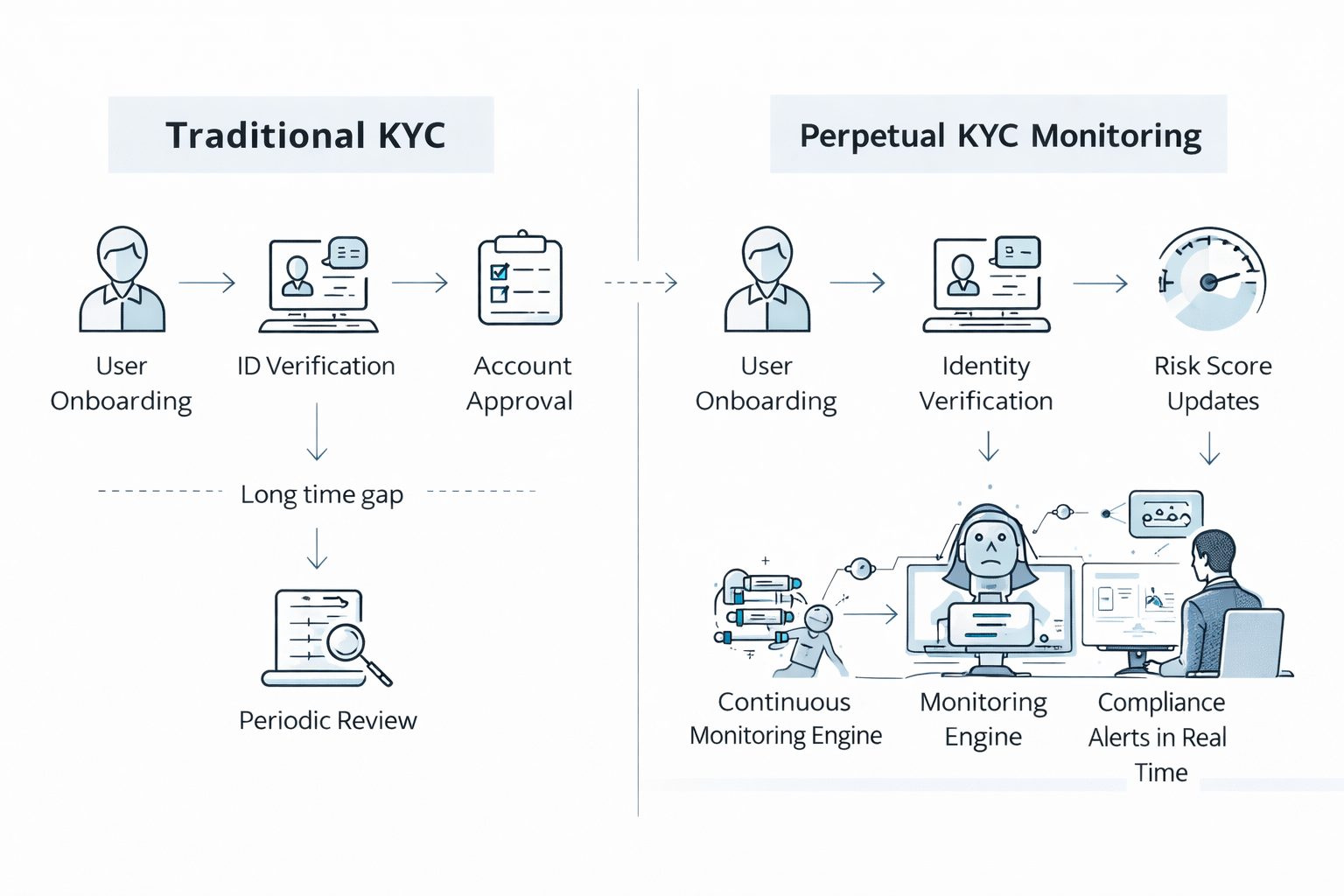
The compliance model that most crypto businesses were built on was borrowed from traditional finance and never fully fit the industry. Verify the customer once at onboarding. File the paperwork. Move on. That model is now a regulatory liability.
A customer's risk profile is not static. They move to a sanctioned country. They begin transacting with flagged wallets. Their source of funds changes. They open accounts on exchanges that later get blacklisted. Static KYC, the kind that checks an ID once and considers the job done, captures none of this. Regulators in the UK, EU, and increasingly the US have made clear that one-time verification is no longer sufficient to meet their expectations for ongoing due diligence.
The industry's answer is Perpetual KYC, abbreviated as pKYC. Rather than scheduling annual or biannual re-verification reviews, pKYC systems continuously refresh a user's risk score based on real-time transaction behaviour, wallet associations, changes in sanctions lists, and external data feeds. The monitoring happens in the background, invisible to compliant users and immediately visible to compliance teams when something shifts.
- For Traders: pKYC means fewer of the intrusive manual re-verification requests that have become a source of friction on legacy platforms. Instead of being pulled out of the platform to resubmit documents every 12 months, your profile updates automatically as long as your behaviour remains consistent with your established risk level.
- For Compliance Teams: pKYC eliminates the regulatory vacuum that exists between onboarding and the next scheduled review. It significantly reduces the risk of account freezes caused by outdated customer data and gives you a defensible, documented audit trail showing continuous monitoring rather than periodic snapshots.
The shift toward Agentic Compliance Workflows takes this further. Autonomous AI agents now perform what practitioners are calling Fincrime Fusion, simultaneously analysing AML risk, fraud signals, and cyber-threat indicators in a single sub-second streaming decision.
Rather than running separate systems for each risk type that generate separate reports reviewed by separate teams, a single decision layer processes the transaction, the counterparty, the behavioural context, and the sanctions environment all at once. The compliance officer in Singapore did not have this. The platforms that do are operating in a different tier of risk management entirely.
For traders who want to understand how their KYC status is maintained on a compliant platform, LBank's verification guide walks through the full process: LBank KYC and Registration Guide. For compliance professionals looking for a structured overview of how these 2026 AML and CFT threats are evolving, the American Bankers Association has published a relevant professional briefing at ABA's 2026 AML/CFT Threat Analysis.
“Static KYC checks a moment in time. Perpetual KYC monitors the entire lifecycle of a customer.”
Solving AML for Protocols That Have No Compliance Officer
Anti-money laundering law has always been built around obligated entities. A bank. A money services business. An exchange. Somebody legally accountable who can be required to collect information, file reports, and freeze accounts when ordered to do so. DeFi protocols, by design, have none of this. The code executes. Liquidity pools fill and empty. Tokens swap. And in many cases, no identifiable legal person is standing behind any of it.
FATF's position on this has hardened considerably. If a person or entity has control or meaningful influence over a DeFi protocol, whether through admin keys, governance voting power, or the ability to modify smart contract parameters, they are classified as a Virtual Asset Service Provider and AML rules apply to them directly.
This is what the industry calls the sufficient influence test, and it has created significant legal uncertainty for DAO contributors, liquidity providers, and developers who thought building permissionless infrastructure kept them outside regulatory reach.
The consequences are no longer theoretical. The Tornado Cash sanctions demonstrated that the US Treasury is willing to sanction a smart contract itself, not just the people behind it. Regulatory pressure on DEX front-ends has shown that hosting a user interface that routes trades through a decentralised protocol may be enough to trigger VASP obligations in several jurisdictions. These are signals the industry has not finished processing.
On-Chain Forensics and the Tainted Wallet Problem
Even exchanges with robust compliance programs face a specific challenge when their customers interact with DeFi. Funds that pass through bridges, mixers, or multi-hop DeFi routes become difficult to trace using traditional blockchain analytics. A wallet can appear clean at the point of deposit while carrying exposure from three or four transactions back in a chain that touched a sanctioned address.
On-chain forensics tools are closing this gap. New capabilities allow compliance systems to flag tainted wallets before they interact with a liquidity pool or initiate a deposit, not after the fact when the damage is done. The practical implication for businesses is that your AML exposure is not limited to your direct customers. If your platform has any touchpoint with DeFi, the liability follows the funds, and you need visibility into the full transaction lineage, not just the immediate source.
For traders who want the benefits of token swaps without the compliance uncertainty of interacting directly with DEX protocols, LBank's Convert feature offers a compliant, custodied alternative: LBank Convert. It gives you the flexibility of swapping tokens with the safety of operating inside a regulated environment where tainted wallet exposure is monitored before it reaches your account.
Zero-Knowledge Proofs and the Rise of Programmable Compliance
The deepest tension in DeFi compliance is philosophical. Users value pseudonymity as a feature, not a bug. Regulators demand identification as a non-negotiable condition of legal operation. For years, the assumption was that these two things were fundamentally irreconcilable and that one would eventually have to give way entirely.
Zero-Knowledge proof technology offers a middle path that is increasingly being taken seriously by both sides of that debate. The concept is called Programmable Compliance, and it works through what practitioners call Selective Disclosure.
A user can cryptographically prove to a decentralised protocol that they are a verified human, that they are not on a sanctions list, or that their funds originate from a clean and documented source, all without revealing their specific identity to the protocol or creating a centralised repository of personally identifiable information.
This matters enormously from a privacy and security standpoint. Centralised KYC databases are honeypots. They concentrate sensitive personal information in a single location that becomes a high-value target for both hackers and state actors. ZK-based compliance layers allow the FATF Travel Rule's verification requirements to be satisfied without creating that honeypot.
The user's identity is verified once by a trusted credential issuer. What gets transmitted to the protocol is proof of compliance status, not the underlying data. Projects across the DeFi ecosystem are already building this infrastructure. It is the most technically credible path toward compliance that does not require decentralised protocols to become centralised surveillance systems.
“ZK compliance proves you are verified without revealing who you are.”
The Travel Rule as Industry Standard Infrastructure
The FATF Travel Rule has existed in traditional finance for decades. When a wire transfer exceeds a threshold, the originating bank must collect the sender's and receiver's identifying information and transmit it to the receiving bank. The logic is straightforward. The implementation in crypto is anything but.
The Travel Rule now applies to crypto transfers exceeding $1,000 in most jurisdictions that have adopted FATF standards. When a transfer hits that threshold, the originating platform must collect and transmit KYC data about both parties to the receiving platform. The problem is that blockchain transactions have no built-in messaging layer for this data. A wire transfer has SWIFT. A crypto transaction has a hash, a wallet address, and nothing else.
- For Traders: This is why you may now be asked for a recipient's name, or even documentation of ownership, when withdrawing funds to a self-custody wallet above $1,000. Regulators in multiple jurisdictions have extended the Travel Rule to unhosted wallets, requiring exchanges to collect information about who controls the destination address before the transaction is processed. It is not an arbitrary request. It is a legal obligation that the platform is operating under.
- For Compliance Teams: The unhosted wallet question is one of the most operationally contested areas in current AML compliance. Different jurisdictions handle it differently, and the regulatory standard is still evolving. Document your methodology carefully and review it against current guidance in each market you serve.
For a clear explanation of how these withdrawal requirements are applied on a compliant platform, LBank's withdrawal and security policy covers the relevant prompts traders will encounter: LBank Withdrawal and Security Policy.
Solving the Interoperability Problem
The bigger operational challenge for compliance teams is not understanding the Travel Rule. It is implementing it across a fragmented ecosystem of competing solutions. TRUST, Sygna, and VerifyVASP are the most widely adopted platforms for Travel Rule data exchange. None of them talks to each other natively.
When your platform uses one solution, and your counterparty uses another, the data packet does not transfer seamlessly. That gap is a compliance risk and a potential liability if regulators determine that a transfer was processed without proper Travel Rule data exchange.
The industry is moving toward resolution of this through the adoption of IVMS101, the International Virtual Asset Message Standard, as a universal data format for Travel Rule compliance. IVMS101 defines how sender and receiver information should be structured, encoded, and transmitted between platforms, regardless of which compliance software each party uses.
Overcoming what practitioners call the Travel Rule Sunrise Issue, the period where some platforms were compliant, and others were not, requires cross-border data packet integrity, and IVMS101 is the closest thing the industry currently has to a shared standard.
For compliance teams choosing a Travel Rule solution today, interoperability with IVMS101-compatible counterparties should be a primary evaluation criterion. The solution you select is not just a compliance tool. It is a long-term infrastructure decision that will determine which counterparty VASPs your platform can transact with cleanly and which ones will create friction and documentation gaps.
ACAMS, the global standard-bearer for AML professional development, covers the latest Travel Rule developments and broader AML news at ACAMS News. For compliance professionals, this is one of the most reliable sources for tracking how regulatory expectations are being interpreted and enforced in practice.
“Compliance infrastructure is becoming as critical to crypto as payment rails.”

Why Compliance Is Now a Competitive Advantage
The crypto market is splitting into two tiers, and the split is accelerating. On one side are platforms with credible, documented, and technology-backed AML programs. They retain their banking relationships. They attract institutional clients who cannot touch anything that has not passed a compliance review. They operate in major markets without the constant threat of a regulatory action that shuts down their payment rails overnight.
On the other side are platforms without those programs. They are losing correspondent banking access. They are being blocked from the payment infrastructure. They are watching their institutional client pipeline close.
This is not a prediction. It is a description of what is already happening. The compliance officer in Singapore was on the right side of that divide in most respects. Her platform had systems and policies. What she discovered is that in 2026, having systems is not enough. The systems have to produce the kind of real-time, documented, auditable visibility that a correspondent bank's algorithm is going to evaluate automatically, without a phone call, without a grace period, and without an opportunity to explain what you meant to do.
- For Business Owners: AML compliance is no longer a cost centre. It is the infrastructure that determines whether you can operate at scale, access banking, and serve institutional clients. Platforms that treat compliance as a checkbox are finding that the checkbox has become a barrier to everything they want to build.
- For Traders: The robustness of your platform's AML program is a direct safety net for your funds. Exchanges with strong compliance infrastructure are far less likely to face sudden regulatory actions, banking suspensions, or withdrawal freezes that leave customers unable to access their assets. Choosing where to trade is now partly a due diligence decision.
“AML compliance is no longer a cost centre. It is the infrastructure that determines whether you can operate.”
The direction this is heading is not ambiguous. Regulators are not going to reduce their expectations. Blockchain analytics tools are getting better at tracing funds through DeFi. ZK-based compliance layers are making it possible to verify users without creating surveillance infrastructure.
Agentic AI is making real-time monitoring feasible at scale. The technical and regulatory conditions are converging toward a single standard, and the businesses that build toward that standard now will be the ones still operating when it fully arrives.
One practical step every trader should take is to verify they are engaging with official, authenticated platform channels. Scams increasingly mimic legitimate exchange communications. LBank's Official Verification Centre lets you confirm whether a channel, account, or communication is genuinely from LBank before you act on it: LBank Official Verification Centre. On a platform built around compliance, protecting users from social engineering and impersonation is part of the same program that protects them from financial crime.
The compliance officer in Singapore did not lose her banking relationship because crypto is broken. She lost it because her visibility did not match the standard the financial system now requires. That standard is only going one direction. The question for every business in this industry is not whether to meet it. It is how fast they can build the systems to get there.


